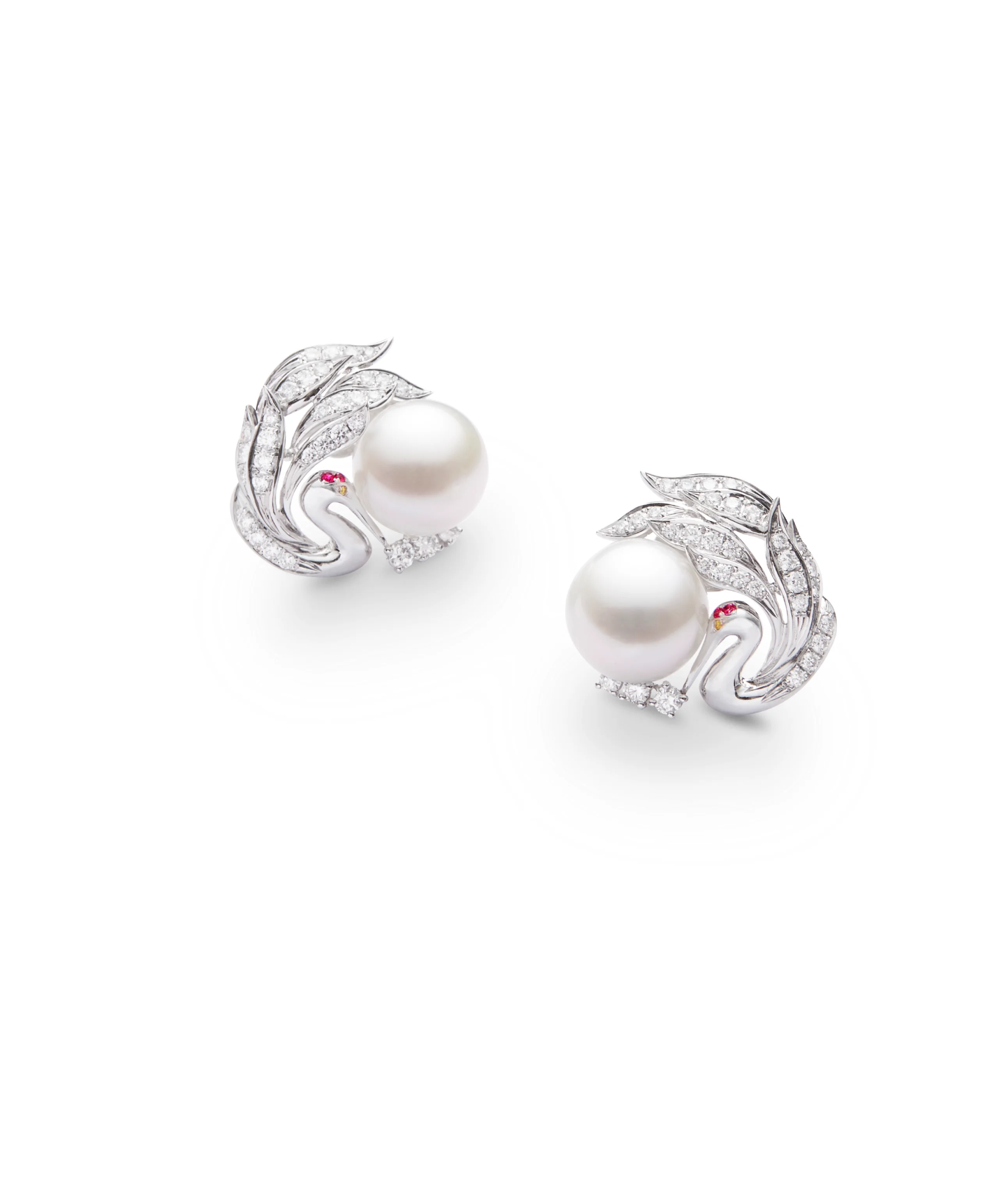
Red-Crowned Crane
Center Stone|South Sea Pearl 12 mm
Accent Stone|Yellow Diamond 0.01 ct, Diamond 1.08 ct, Ruby 0.03 ct
Precious Metal|18K White Gold
Story Behind the Work
Red-Crowned Crane
The red-crowned crane is one of the most graceful and revered birds in East Asian culture. Since ancient times, it has been regarded as the mount of immortals, earning it the poetic name “celestial crane.” It has long appeared as a symbol of auspiciousness in literature and painting. During the Ming and Qing dynasties, the crane was also featured on the insignia of first-rank civil officials, representing status and distinction.
Red-crowned cranes can live for up to sixty years and are known for forming enduring pair bonds. For this reason, they have come to symbolize longevity and devotion in East Asian culture.
In this pair of earrings, two red-crowned cranes face one another as if dancing gracefully together. Rubies set at their crowns provide a vivid finishing touch, standing out against the luminous white brilliance of South Sea pearls and diamonds and lending the design an almost celestial quality.
South Sea Pearl
South Sea pearls are cultured in the saltwater oyster Pinctada maxima, with major sources including Australia, Indonesia, the Philippines, Myanmar, and Thailand. Silver-white South Sea pearls are particularly associated with Australia, while golden varieties are predominantly produced in Indonesia and the Philippines.
Among the oysters used for cultured saltwater pearls, Pinctada maxima is the largest species. South Sea pearls can reach up to 20 mm in diameter, although sizes between 10 and 13 mm are more commonly seen in the market. The oysters generally reach three to four years of age before their first nucleation, with only one nucleus implanted at a time. Each cultivation cycle typically lasts two to three years, during which the oysters must withstand disease, changes in water temperature, and severe weather conditions before the pearls can be harvested. Only a small proportion of oysters successfully undergo multiple nucleations and produce pearls again, making each South Sea pearl the result of a long and demanding cultivation process. Pearls exceeding 14 mm are particularly rare and highly valued.
South Sea pearls are prized for their soft, silky luster, which beautifully complements the refined elegance of a mature woman. Whether worn individually or incorporated into a strand, their luminous presence naturally draws the eye.

Craft Your Heirloom
Your Family’s Spirit, Carried Forward.